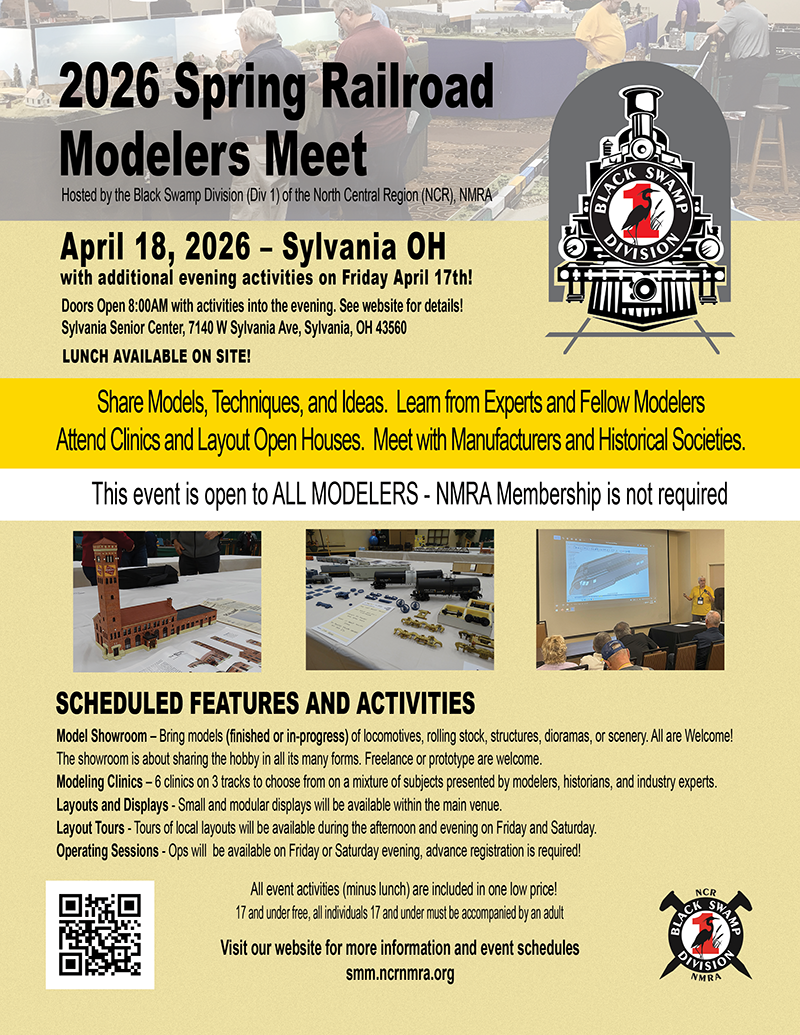
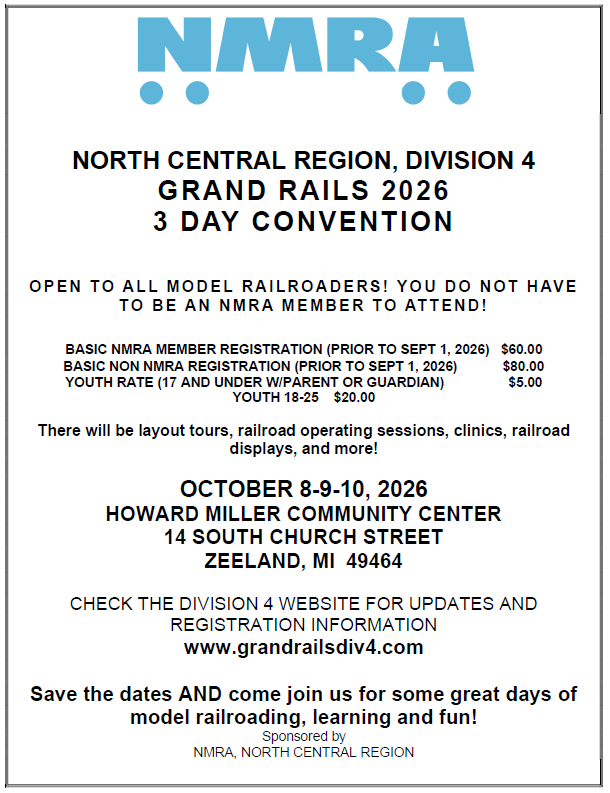
NCR Black Swamp Division (Div 1) Officers
Superintendent - Marshall Stull Assistant Superintendent - Brian Burr Chief Clerk - Ray Huber Treasurer - Randy Bosscher Trainmaster for Services - Steve Glass Director At Large - David McMullian Director At Large - Tony Kukwa
Appointments and Helpers
AP Program - Ron Gilbert Editor/Webmaster - Marshall Stull AV/Computer Support - Steve Glass AV/Computer Support - Steve Richwine New Member Outreach - Steve Kapela
We Need Help!
We need stuff for the Train Order! Please submit any article/photo/information/news to the editor. any kind of information is great, please tell us what you are up to!! Even if it's just a photo of your layout, something you saw, or what's on your worktable we would love to see it.
Sharing is the best way to spread the hobby and ideas.
 Train Order
Our mission is to promote education and fellowship through the sharing of information and the promotion of the world's greatest hobby. - Model Railroading.
From the Editor
November already! The Christmas decorations are starting to appear and the food is improving, while the weather, well, not so much...
Our last meeting had some technical issues, like the thumb drive being left at home, and having to wing the presentations. To help make up for some of that, in this issue I have converted the clinic into a story about the building of the NW Ferry Detroit. It's not totally inclusive but should help spread some light on the details of how the build went.
BIG REMINDER - The next meeting will be on SATURDAY November 15th at the Holland Library at 1:00PM (doors open at 12PM). NOT FRIDAY!!!!
Check out the details in the meeting
section below.
I hope you enjoy this issue of the Train Order!
WANTED! - Photos, Articles, News for the Train Order!! I have seen some of you with layouts at the spring train shows. Why not send a few photos of the layouts and tell others what fun you had! Send a photo and a small paragraph. It does not need to be professional, just jot it down in an email and fire away. Any content is welcome. Email any content, ideas or news to the editor at blackswampdiv@div1.ncrnmra.org.
View from the Cab
The last couple meetings have had a lot of discussion about the future of the NMRA and the NCR. These things of course affect us in Division 1. If you have not seen it, the new NMRA Logo has been released and has been on the NMRA website since November 1st. we will have more discussion on these changes at our next meeting. To be honest there is so much to absorb, I am still not up to speed on everything that is going on. I will make my best effort to have a summary at the next meeting.
Small Layout Meet - Last month we have run into some issues with the venue for the meet. Prices have jumped up a little and we were concerned about not being able to make ends meet even if we hit our attendance goals. On November 1st, the NCR had its board meeting and Division 1 asked for some assistance and the NCR came through for us. we will review the details at the November meeting but needless to say, we can move forward with the meet as planned.
Division 1 Swap Meet/Train Show - Our October meeting showed great enthusiasm for planning a Swap Meet/Train Show for 2027. We even took a look at the Proclaim FM facility which looks very promising. I will be sending around a form for volunteers to help plan the event. I have also been in communication with some vendors who show interest in being part of a future show.
I look forward to seeing everyone at the meeting!
Marshall Stull,
mstull@marshallstull.com
Superintendent
Clinic Corner
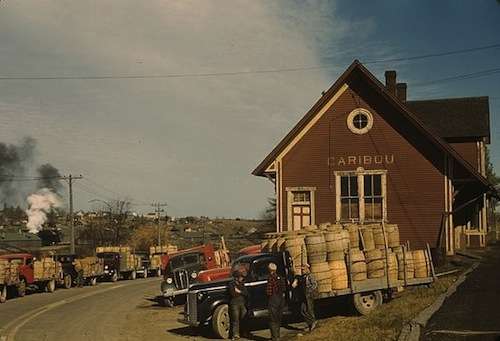
It's November! Time to think about Thanksgiving and comfort food, and one of my favorites are potatoes.
This month Dave McMullian is going to give us a taste of the Maine potato industry in the 1950's. From the potato houses near Mars Hill to the docks of Searsport, and all the infrastructure in between. We'll see what it took to get those spuds to your table, or around the world.
See you there,
Brian Burr,
Assistant Superintendent
November 15th Meeting Agenda
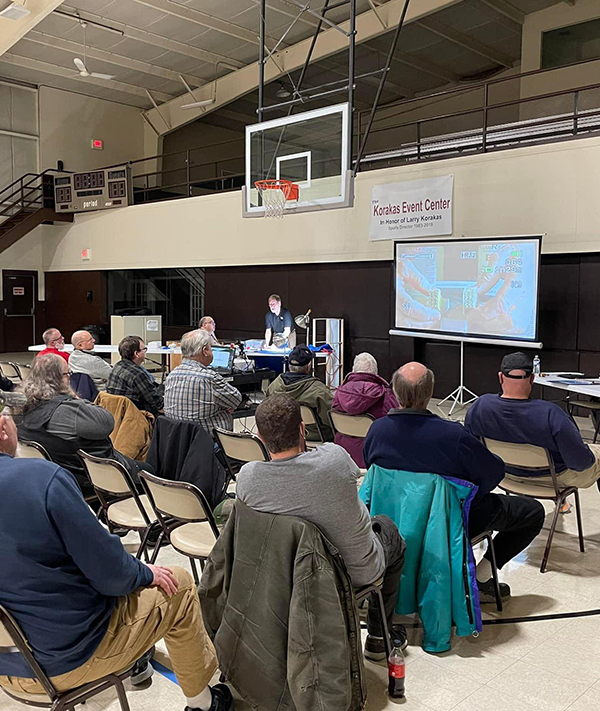
THIS MONTH ONLY - We have a change of day and venue!
- Rip Track Table
- Business
- Q&A - Ask our members about anything
- Show and Tell
- Break
- Door Prizes
- Clinic - Maine Potato Industry
- Closing Remarks - Announcements and Open Discussion Points
Doors open at 12:00PM, Meeting Starts at 1:00PM
Holland Library
1032 S McCord Rd,
Holland, OH 43528.
Join us for breakfast/lunch!
Since we are meeting on a Saturday and around lunch time, please consider stopping at the Grape Leaf Diner (909 S McCord Rd, Holland, OH 43528) and break bread with the membership before
the meeting. The diner opens at 11:00AM.
Everyone is responsible for their own tab. This is an optional extra activity for those who would like to have additional "talk" time.
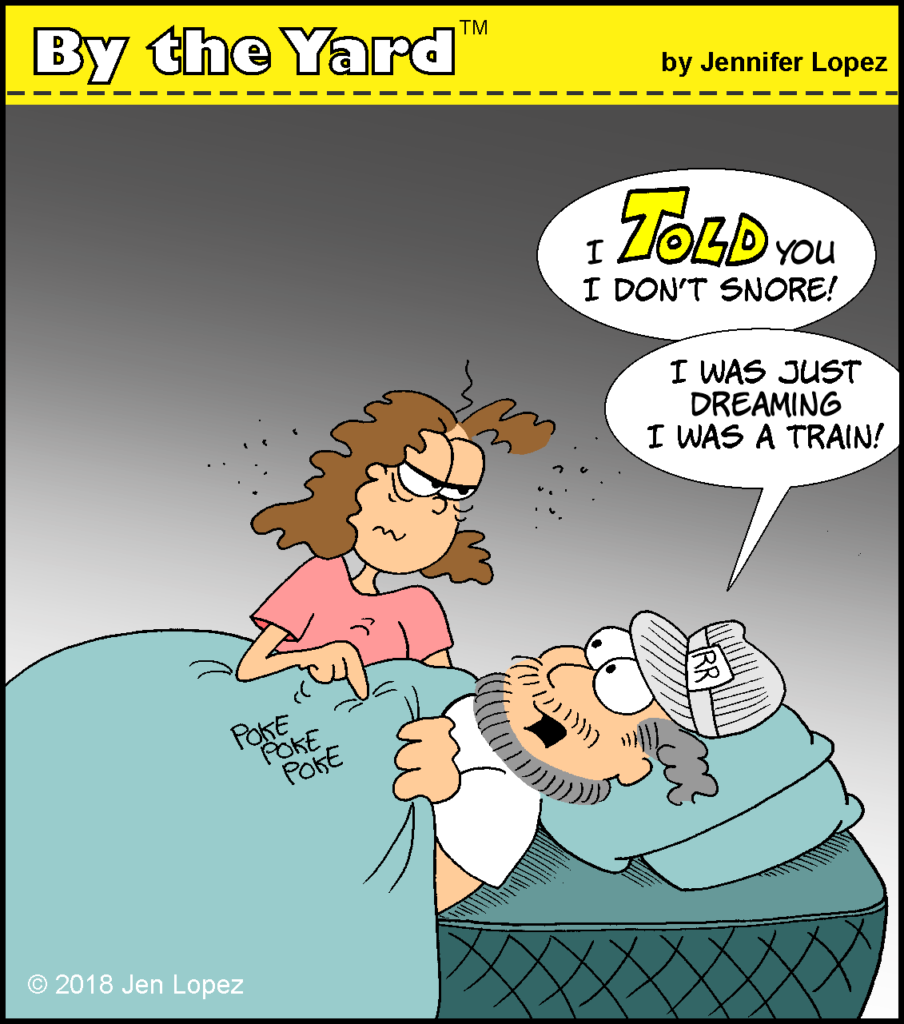
The lighter side of the hobby
October Meeting Highlights
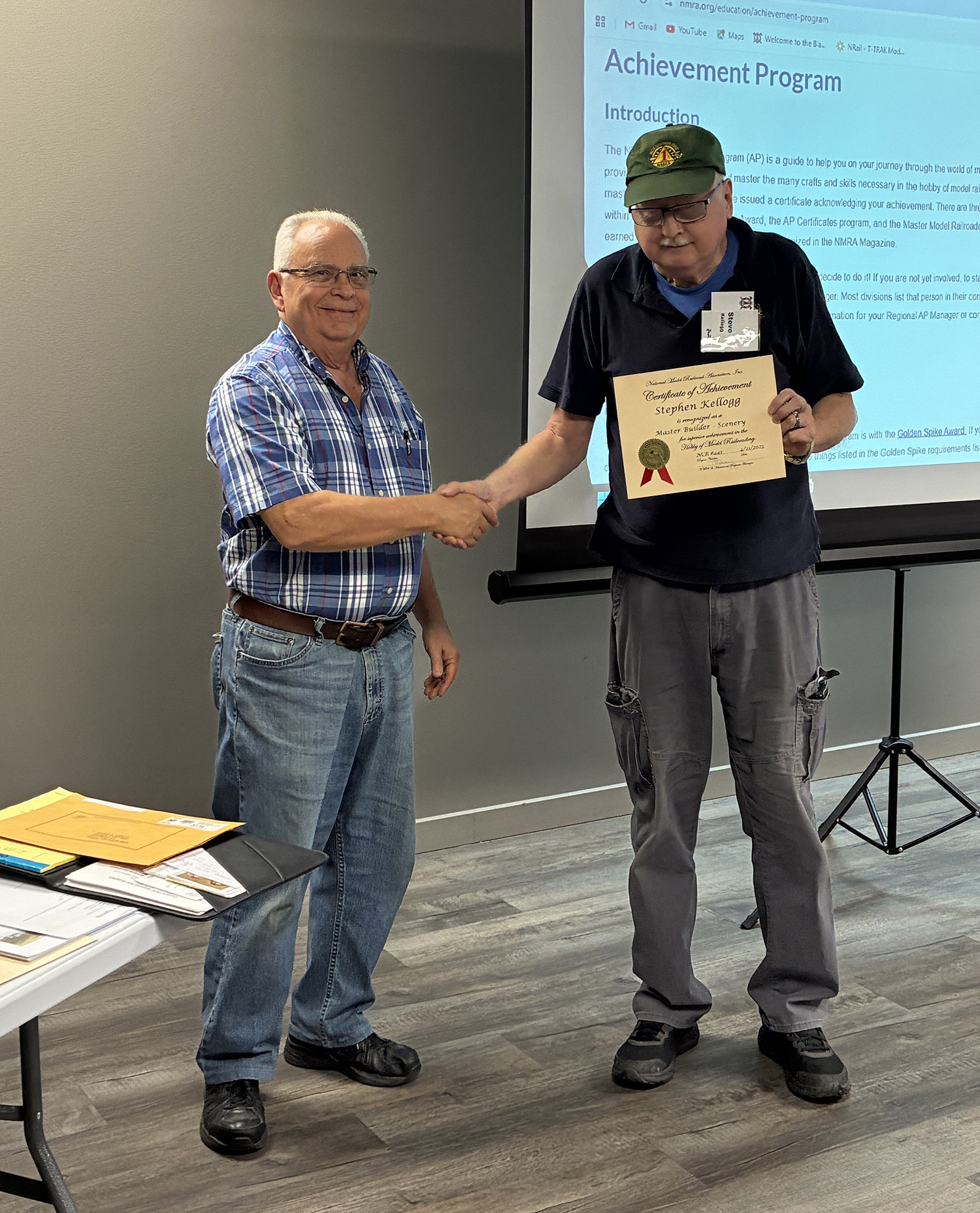
Ron Gilbert presented Steve Kellogg with his AP Certificate for Scenery. Please make sure to congradulate Steve if you see him!!
The following items were brought for Show and Tell in October;
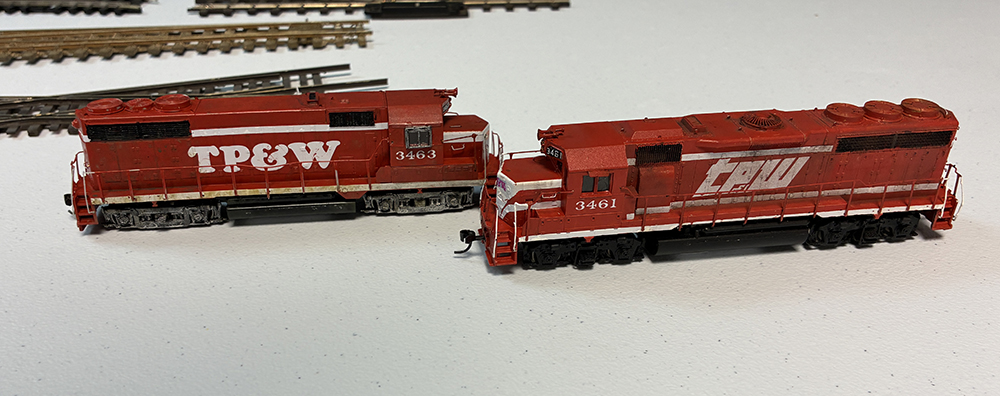
Steve Kellogg displayed two diesel GP-40's he custom painted along with the history of the locomotives.
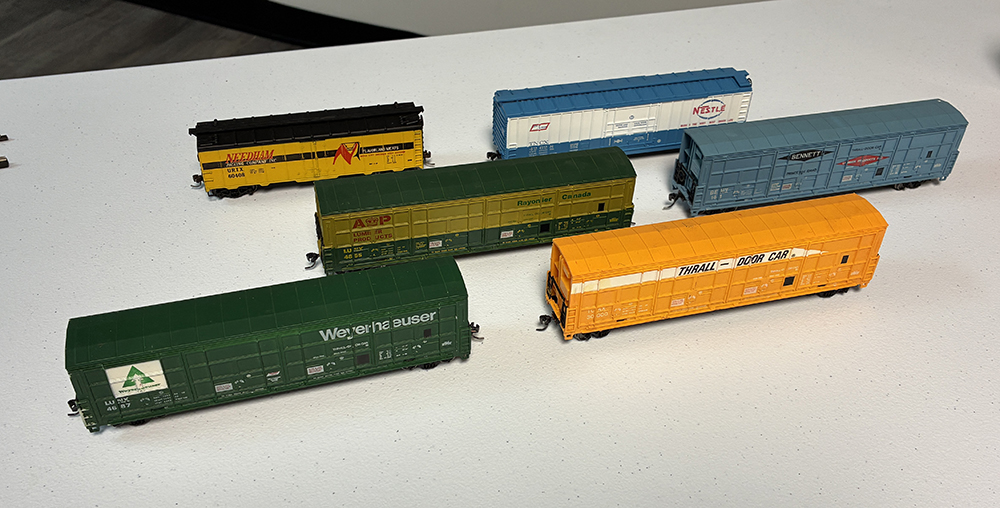
Tony Kukwa displayed some new customized freight cars.
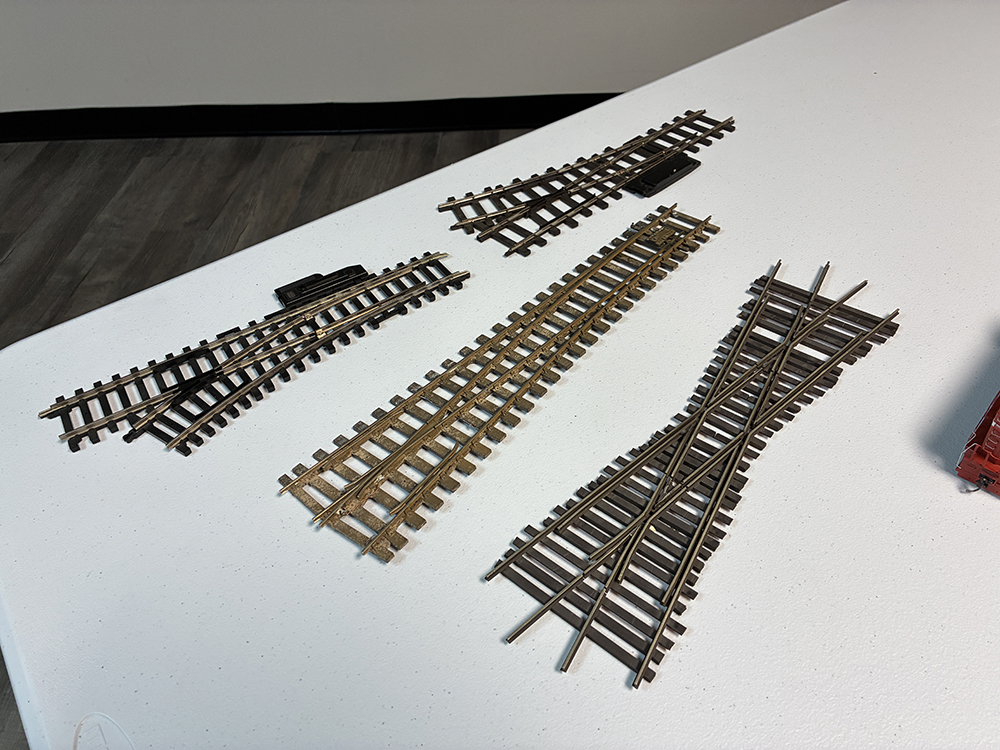
Paul Kemner displayed a few different 0 gauge turnouts. One was a home made Diamons Crossing.
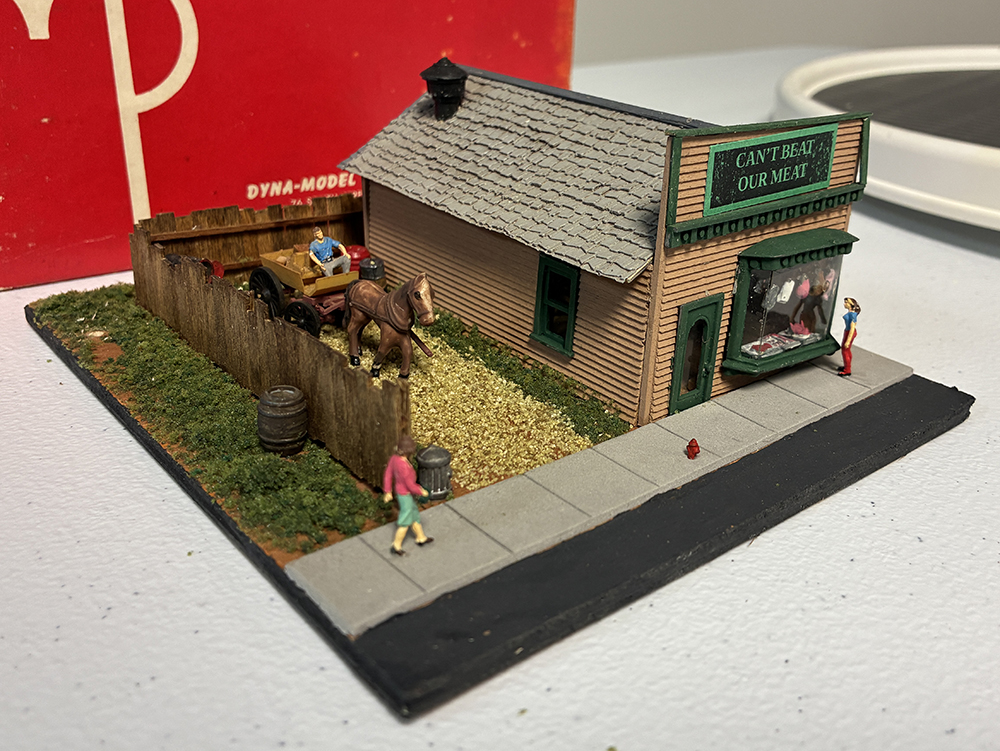
Jim Treadaway displayed a scratch built building. All work done in his new closet work shop.
Building the NW Car Float Detroit
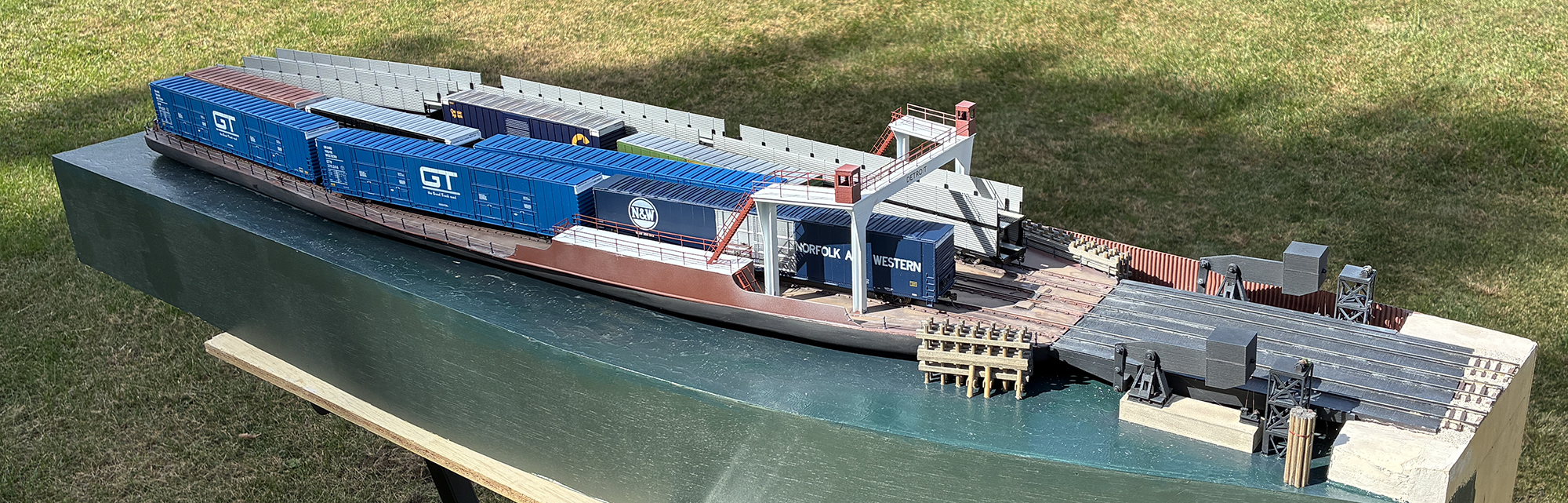
The clinic at the October meeting was on building the NW car float Detroit, but due to technical issues, much of the planned presentation could not be shared. What follows is a brief article with images of how I built the car float and the float bridge.
Why Scratchbuild?
The only available commercial models are no more than three tracks and are based on east coast (New York) barge operations. I am modeling the N&W
Boat Yard circa 1977 as a Free-mo (free-mo.org) module set. The Detroit River had unique boat designs and operations. I also wanted to
simulate Prototype based operations.
I wanted this ferry and the rest of the Boat Yard to be recognizable to any who had viewed the prototype. This left scratchbuilding as the only option.
Short History of Detroit River Car Ferries
Car ferry service across the Detroit River began in 1867 with the Great Western Railroad and continued until 1994.
Early ferries were paddle wheel designs which offered broad decks between the wheels. The Michigan Central, Grand Trunk, Pere Marquette, Wabash, Canadian National and Canadian Pacific
were all involved in ferry operations at both Detroit/Windsor and Port Huron/Sarnia.
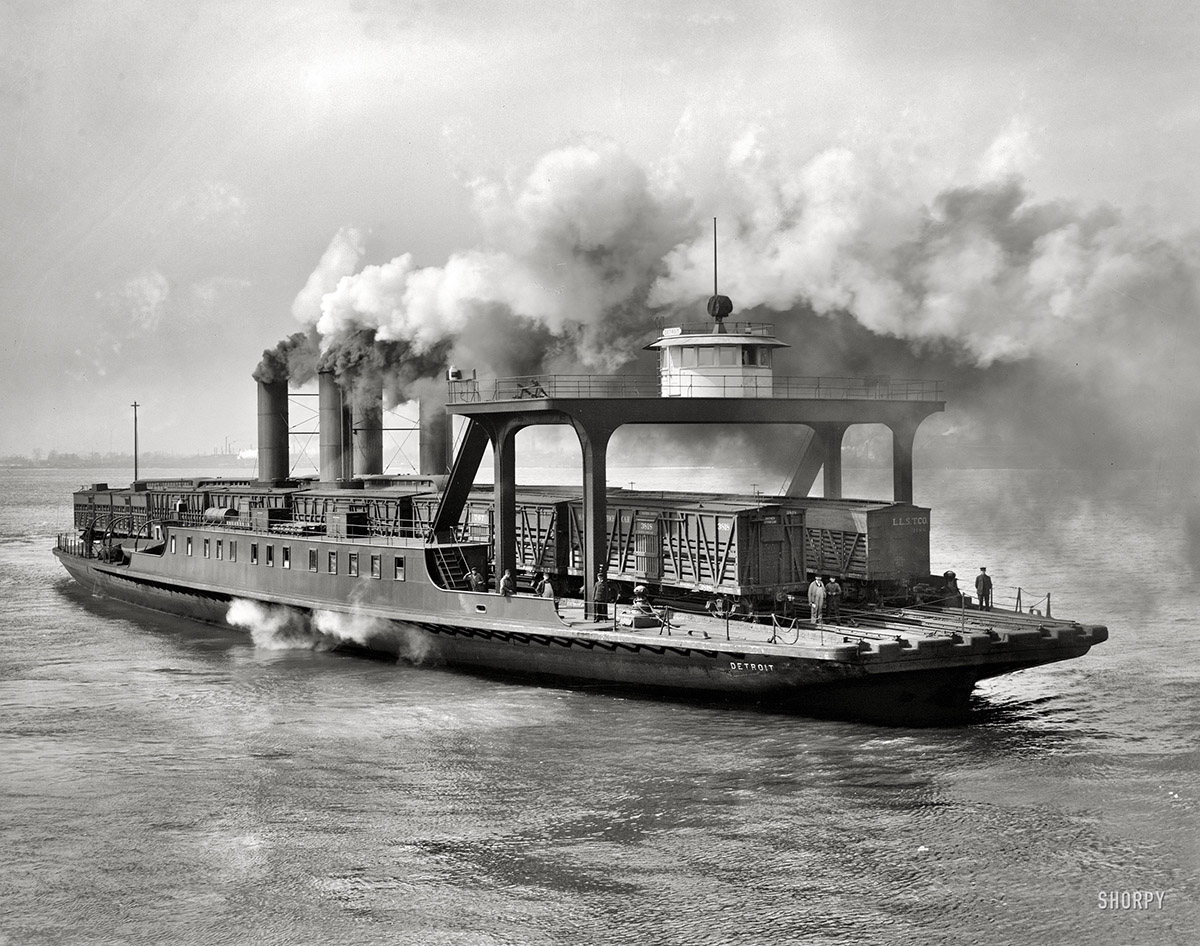
The ferry Detroit was built for the Michigan Central Railroad and entered service on the Detroit River in 1904.
In 1910 the Detroit was sold to the Wabash (MC had opened its tunnel under the river that year).
After the Detroit River Tunnel was completed, ferries continued to transport hazardous and oversize materials across the river, as the tunnel had restrictions on such cargo.
MC stopped ferry operations in 1910, using electric locomotives through a tunnel under the river. MC sold its ferry equipment to other roads. The Detroit was sold to the Wabash in 1912.
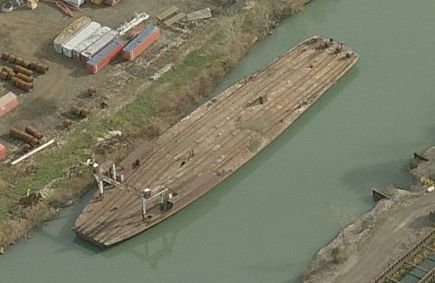
Grand truck stopped Detroit river operations in 1975 when the Detroit Renaissance Center was built over where the docks had been. Detroit River Ferries also served as Ice Breakers and saw service year-round.N&W converted remaining ferries (Detroit, Windsor and Manitowoc to barges in 1969 (GT, C&O and MC had all stopped by this time). All ferry/barge operations ceased in 1994 after enlargement of the tunnel and Norfolk Southern had gained trackage rights. The Detroit was scrapped in Windsor, Ontario, in June 2010. The Huron (CN owned) sank in a slip in River Rouge in 1981 and is still there today.
Design and Construction of the Original
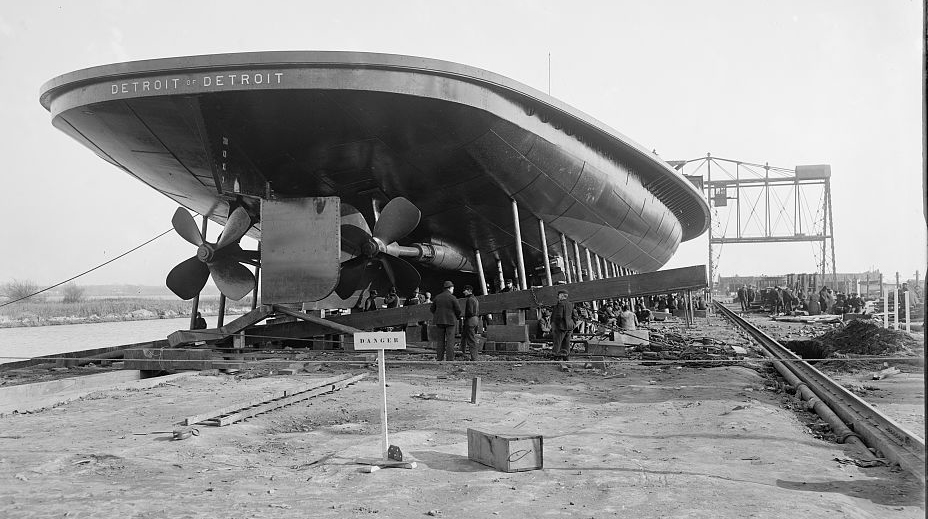
- Built by Great Lakes Engineering Works in 1904
- Dimensions were 296 ft X 64 ft
- Propeller driven with 2 engines fore and 2 engines aft for 3600-hp
- Originaly she had 4 Stacks but was later reduced to 3 then 2. Details are scarce but we have to assume there were some engine modifications with these changes.
- Originally there were 3 Tracks. she was converted to 4 tracks later (when th smokestacks were reduced).
- All engines were removed and the Detroit was converted to barge in 1969.
N&W Takeover
The ferry Detroit was built for the Michigan Central Railroad and entered service on the Detroit River in 1904.
In 1910 the Detroit was sold to the Wabash (MC had opened its tunnel under the river that year).
After the Detroit River Tunnel was completed, ferries continued to transport hazardous and oversize materials across the river, as the tunnel had restrictions on such cargo.
The Wabash became part of N&W in 1964. N&W soon went about changing the cross-river ferries for more economical operations. They upgraded the ferry slips and the Ferries cut down to barges. The N&W used railroad tugs to push the ferries. This cut the workforce from 3 boat crews down to 1.
Modeling Circa 1976-1979
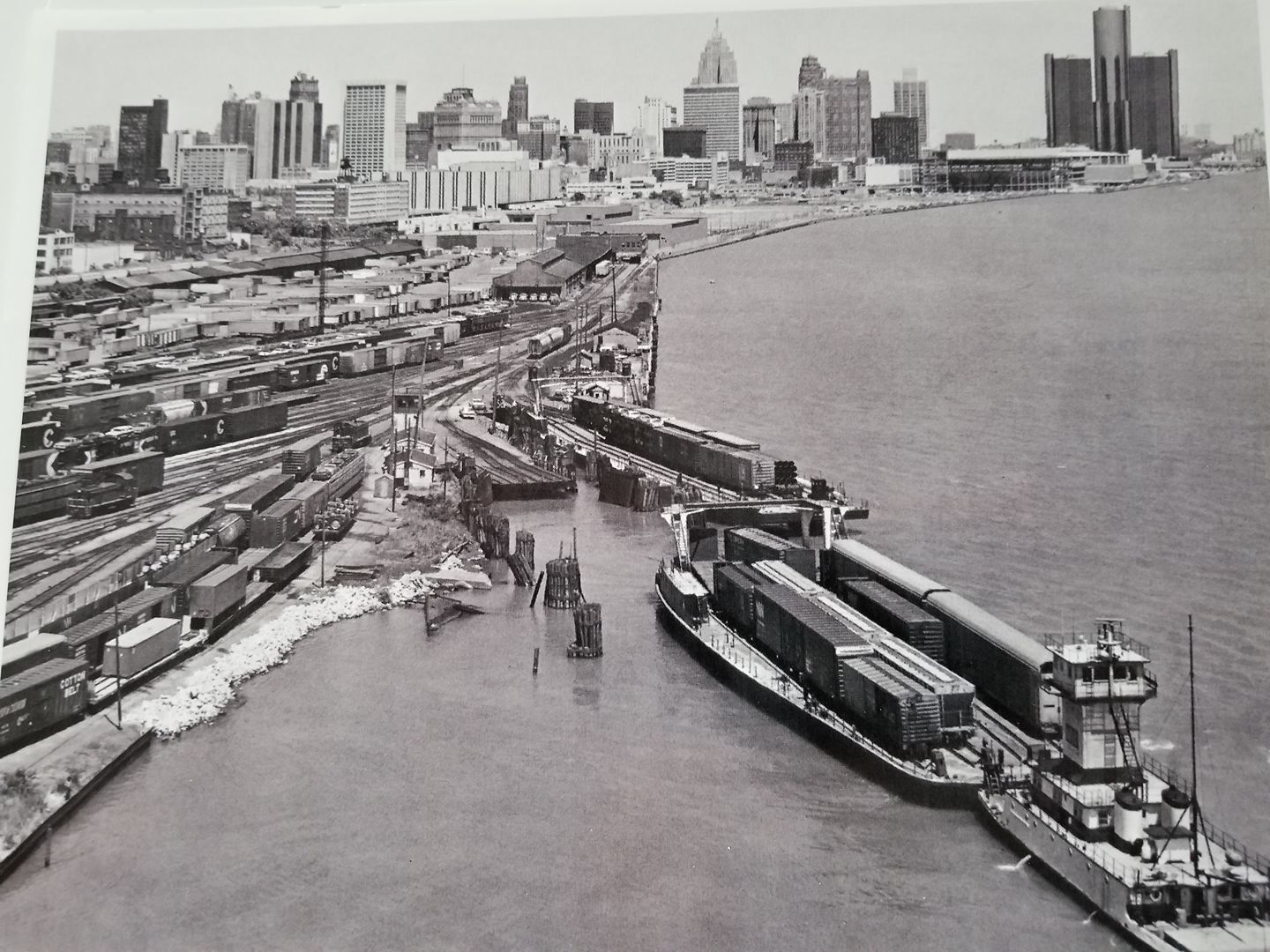
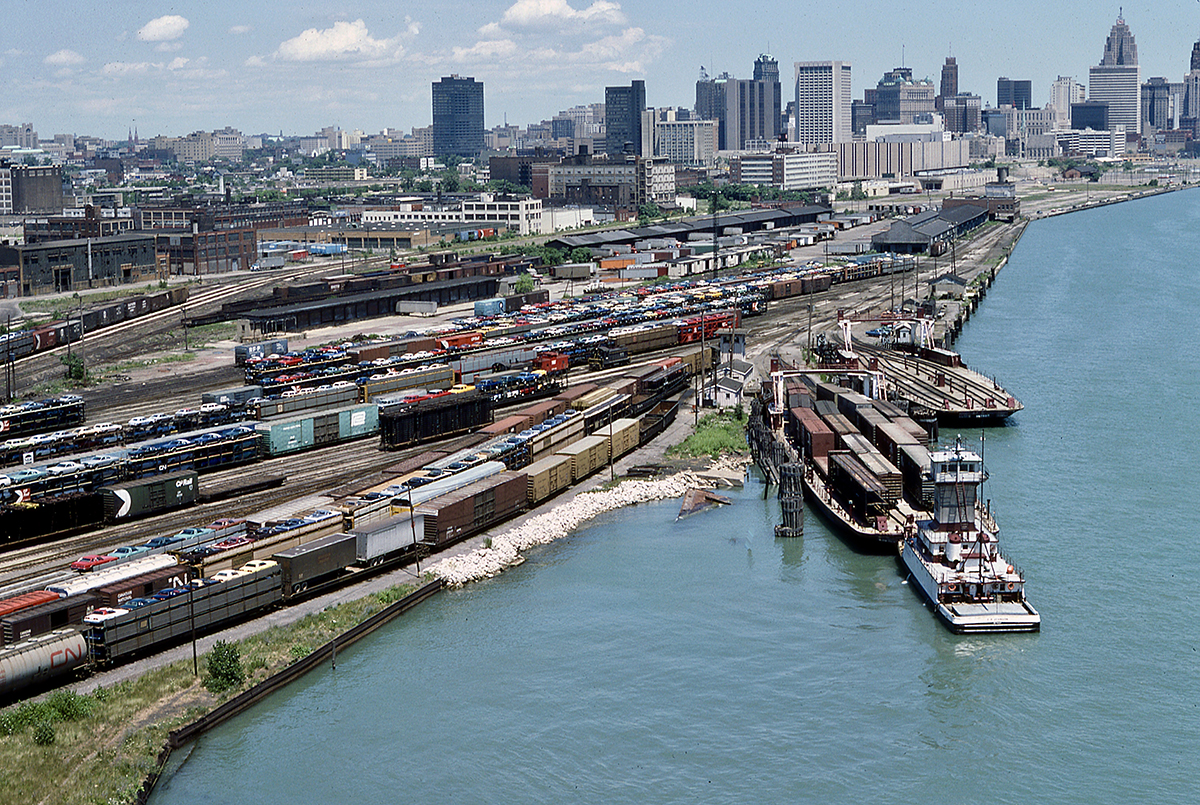
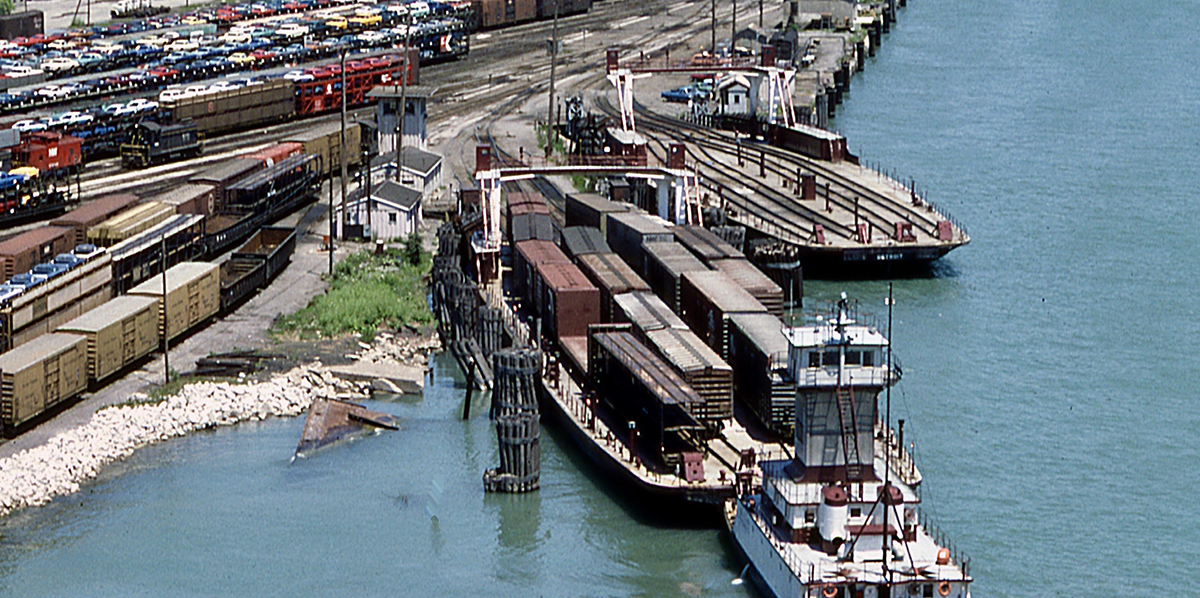
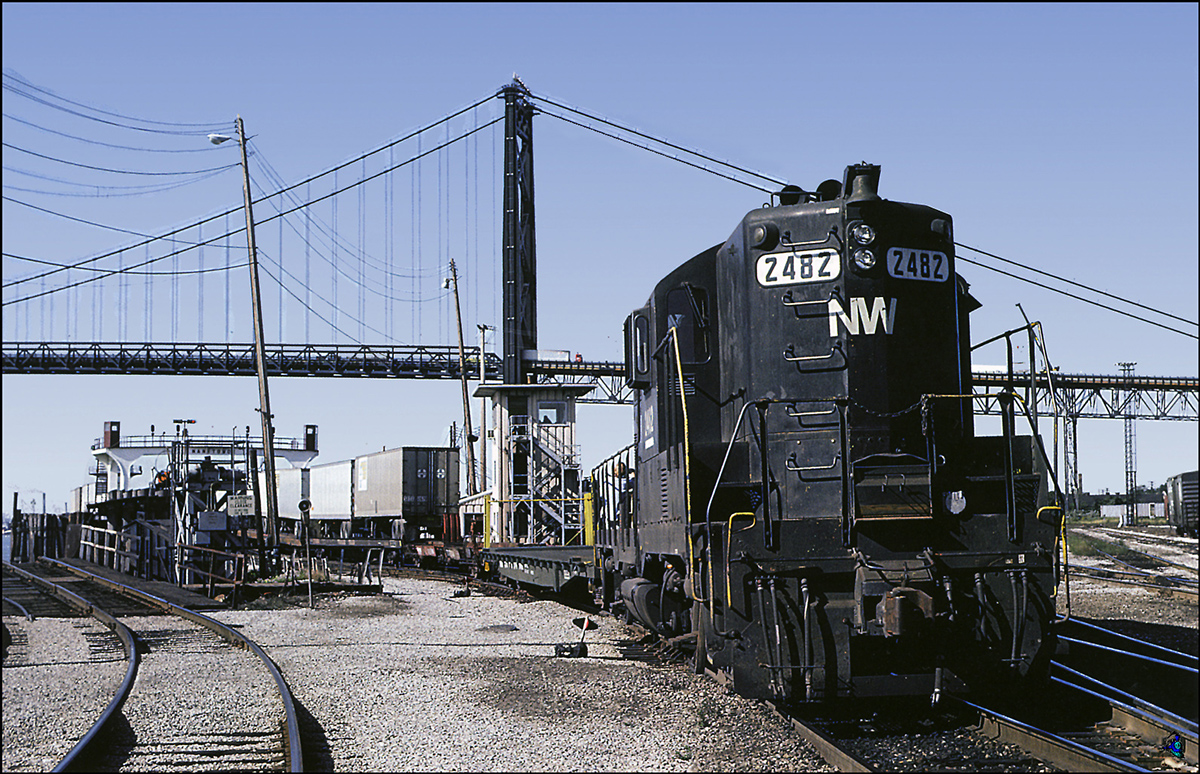
The photo shown is from 1977 (according to the models of vehicles in the photos).
At this time there was still a diverse mix of traffic (prior to NS Traffic Rights through tunnel).
As can be seen in the photo, auto racks and hi-cube cars are waiting to be loaded. This was due to hight restrictions within the original tunnel.
Other forms of cargo included hazardous materials due to tunnel restrictions against corrosive or explosive materials.
Finding Source Materials
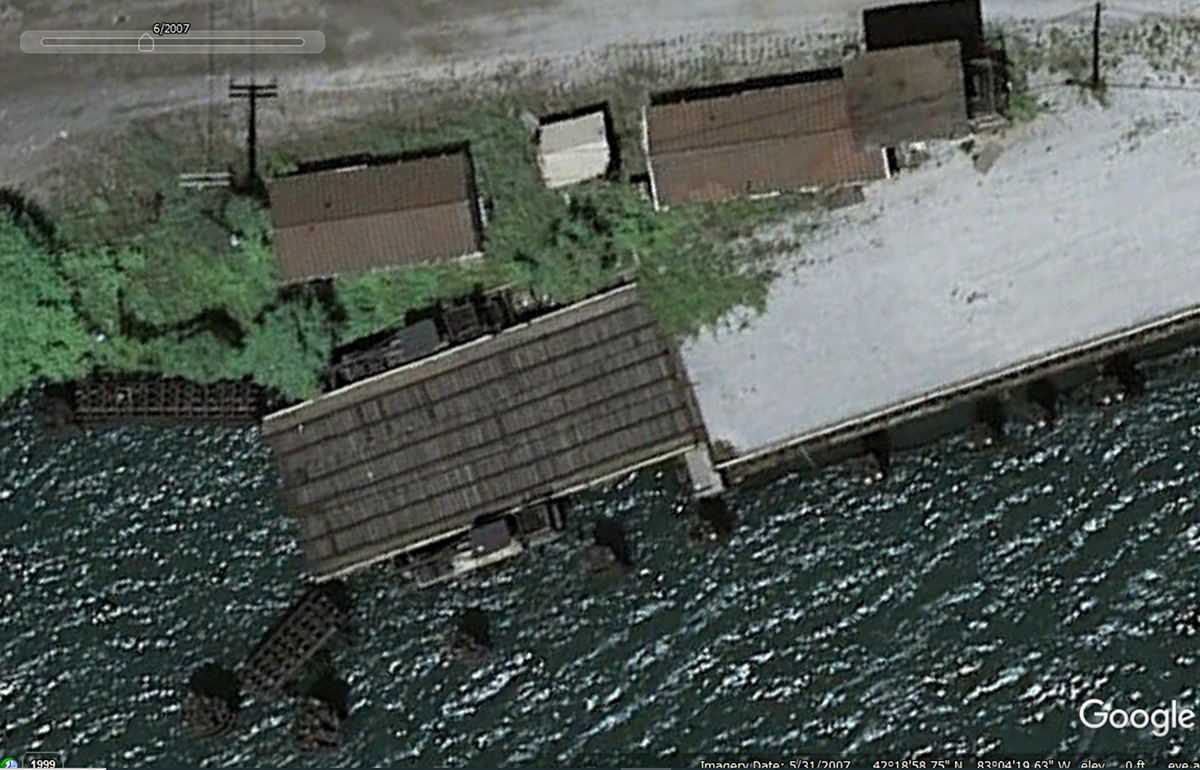
Images from this time are very scarce. Access to the yard was very limited.
Some of the sources used were:
- Contact with former employees
- Books
- Satellite Photos
- Photos from passing fishmen
- N&W Historical Societly (Wabash records)
Building the Hull
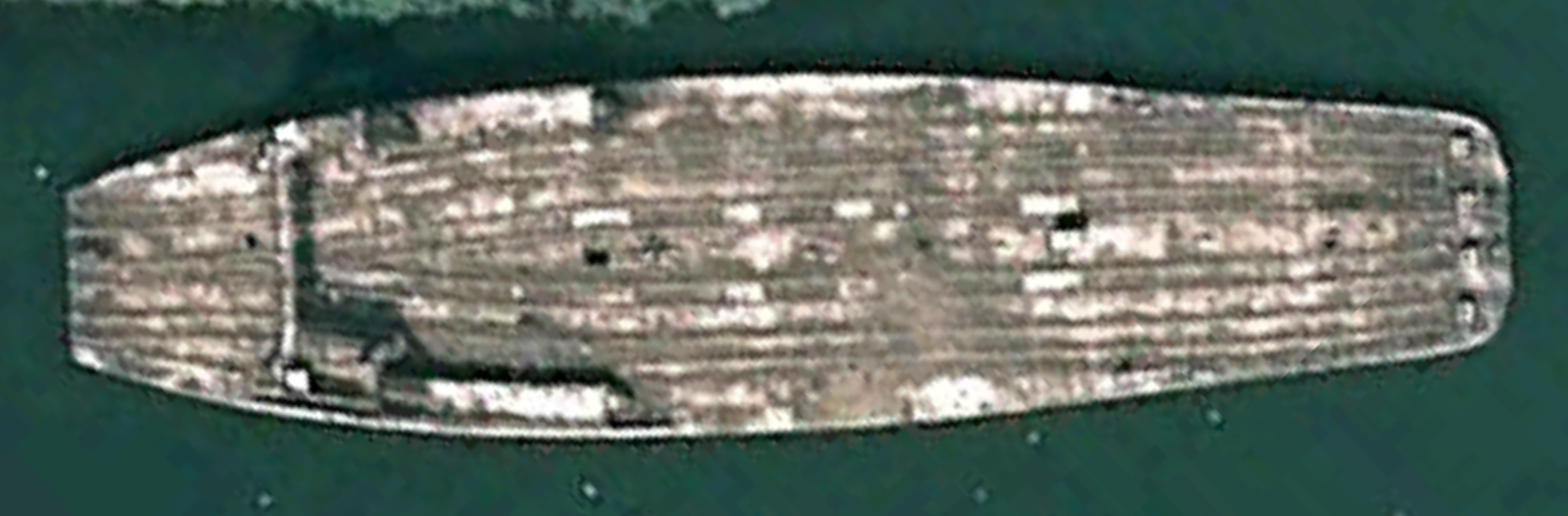
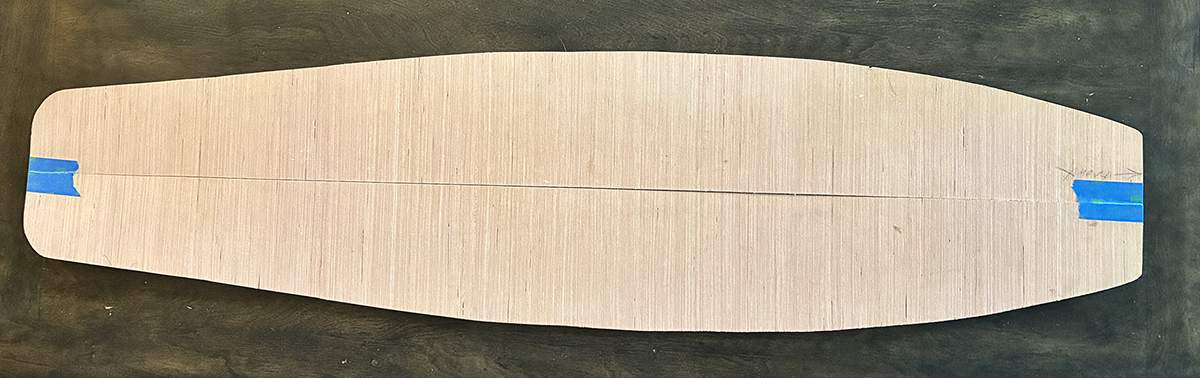
A satellite image (Google Earth) of the Detroit just before scrapping gave me the hull shape.
Dimensional information from historical sources matched the image dimensions
This was used to create template from 1/4" plywood.
The final hull shape was cut with a jigsaw from 3/4" cabinet grade plywood.
A palm sander was used to shape the underside of the hull. A styrene "deck" was applied to the top of the plywood hull to create a smooth surface.
Trackwork
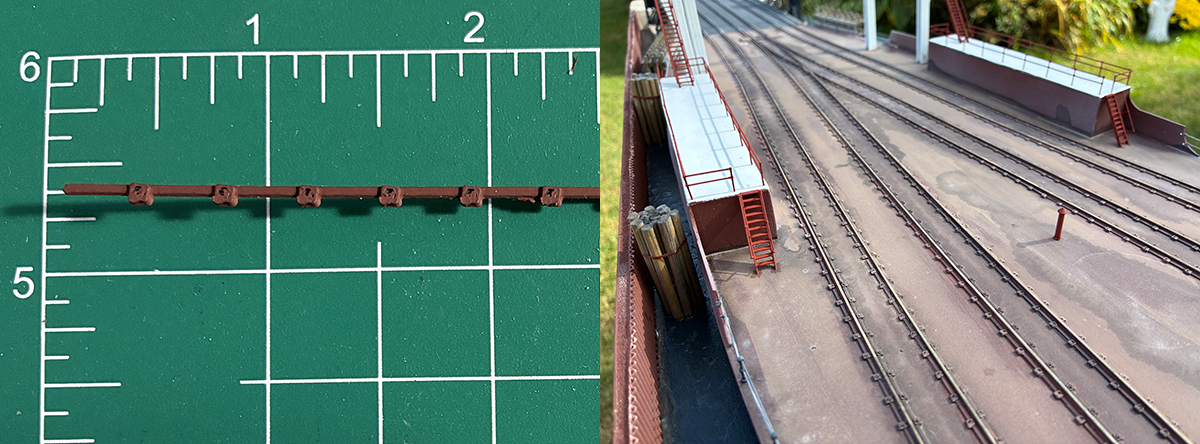
All the rail on the barge and the bridge is Code 83 rail (from flex track) glued in place using ACC.
Curvature of the track follows the curves shown in the satellite images of the prototype.
The turnout on the barge deck was hand laid in place and uses a wire spring to hold its position. Rail chairs on the deck are "simulated" with 3D printed strips of alternating blocks and thin straights glued alongside the rails.
Building the Float Bridge
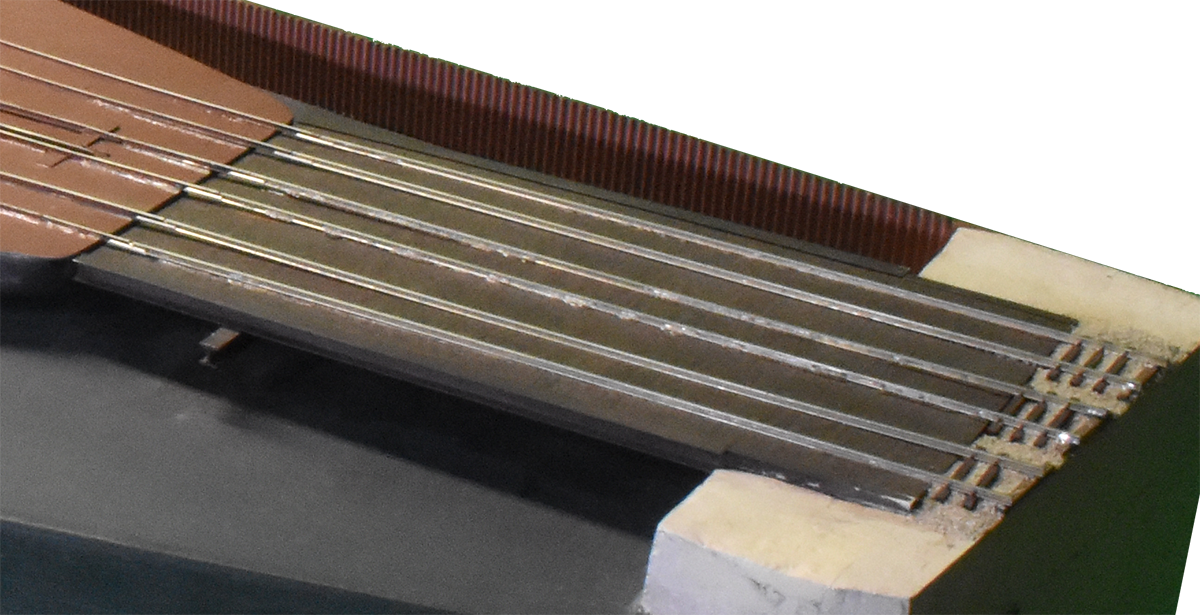
The bridge deck is a single piece of 5mm plywood cut to the basic dimensions (Google maps measurment tool was used to get the dimensions).
The track is code 83 glued down with ACC just like the deck. The bridge ides were originally just plastic I beams from Plastistruct. Later, these were replaced with
3D printed sides which had integral beams for the counterweights to attach to.
On Hold!
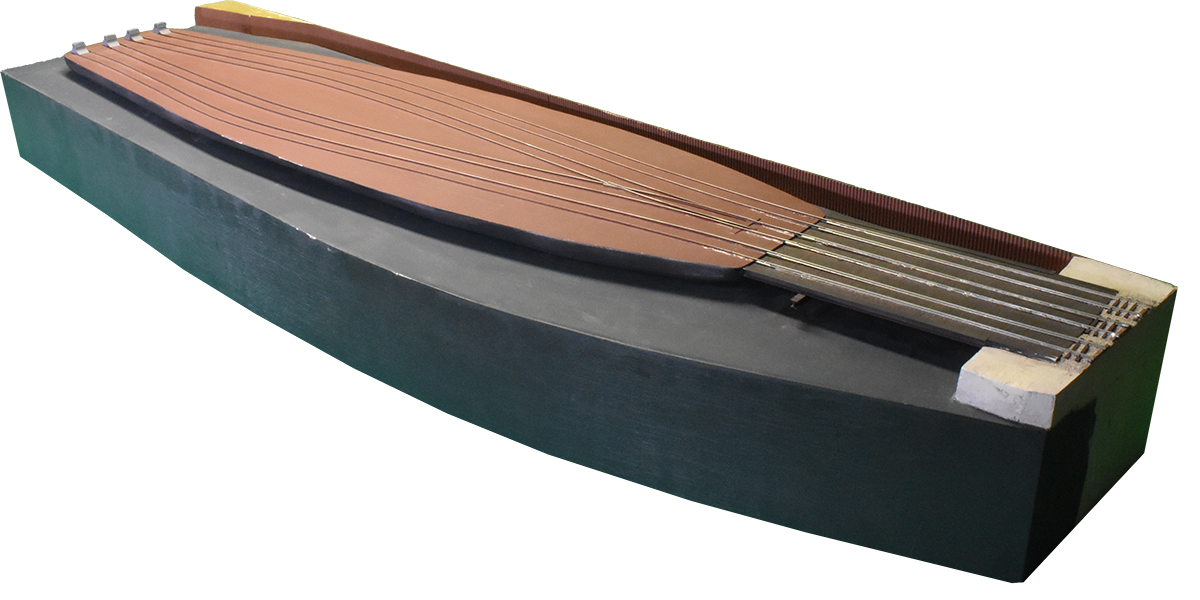
At this point the boat was operational but lacked all the details.
This arrangement was tested in several Free-mo setups and adjustments were made.
These included the angle of the bridge, bridge sides and supports for the bridge and turnout adjustments.
I also suffered from Analysis Paralysis at this point. Images and information about the design/operation of the bridge towers and counterweights had me stopped. I found myself unsure of my own skills to complete the model. There was a lot of unknowns in front of me and I had the desire to follow a prototype that I lacked information on.
Doing My Very Most
To complete the project, I took inspiration from my friend Doug Tagsold.
Instead of worrying about Doing My Very Best, I needed to concentrate on Doing My Very Most
This does not mean to a poor job, it means take a step back do what needs to be done and push ahead.
Some examples of this include:
- Apply handrails but not worry about an exact match.
- Get the basic shape of the counterweights right but worry less about the connection detail.
- The doors of the superstructure will not been seen at most angles so an exact match is not necessary
- Many details are also unkown to the average person. Concetrate on the overall look to give the impression of the prototype.
Building the Superstructure
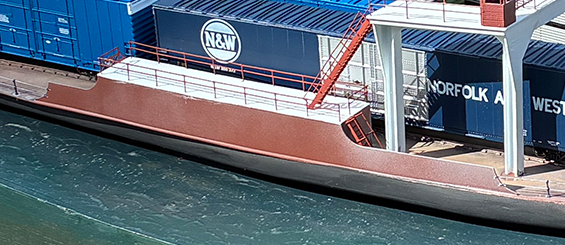
Continuing with the build, I tackled the the deck houses (either side) which are made from pieces of styrene sheet.
The pattern was made in Illustrator.
A Cricut Machine was used to score the styrene.
Doing this allowed me to replicate and mirror each side.
Door shape/style is unknown and was not modeled at this point.
Bridge
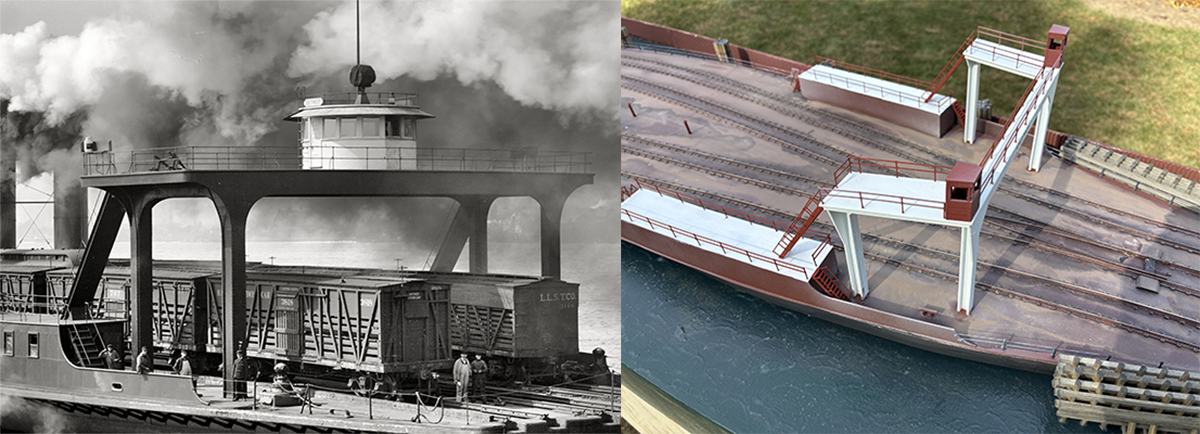
The ferry version had a full bridge with pilot house which was removed in 1969.
The barge version cut back the bridge to a catwalk and installed two small "sheds" on each corner.
I made the bridge by 3D printing one I designed in Sketchup-Free Version.
The Detroit bridge was further forward than it sister boats. It is a unque identifying item.
Railings, Stairs and Ladders
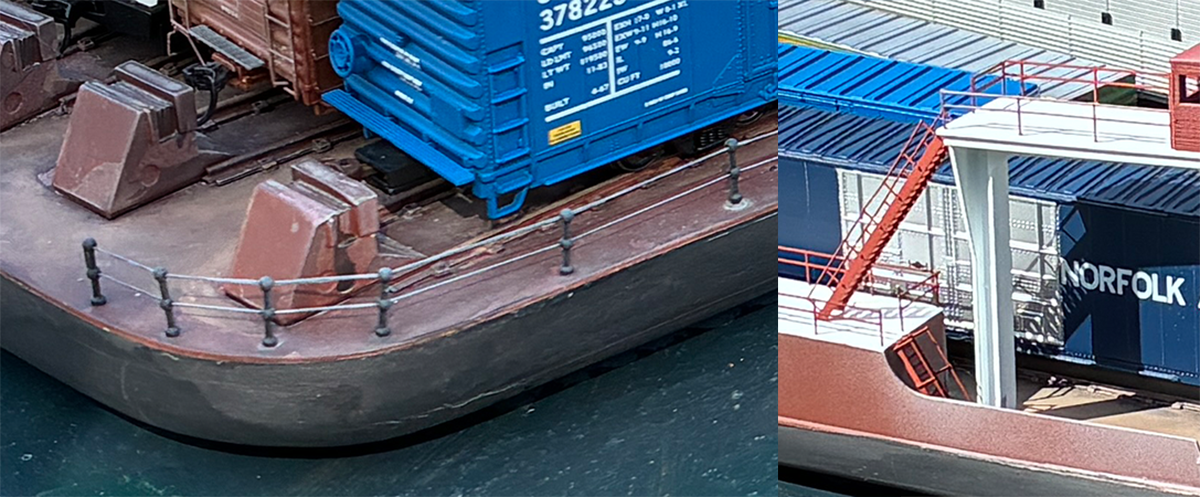
The bridge and Superstructure handrails are 3 rail Tichy handrails cut down to 2 rails
All stairs are from Tichy escape ladder sets with Tichy 3 rail handrails cut down to 1 rail.
The deck railing posts were from a ship model supply company (purchased so long ago, I am not sure which one anymore).
The deck railing lines are Heavy E Z Line in black.
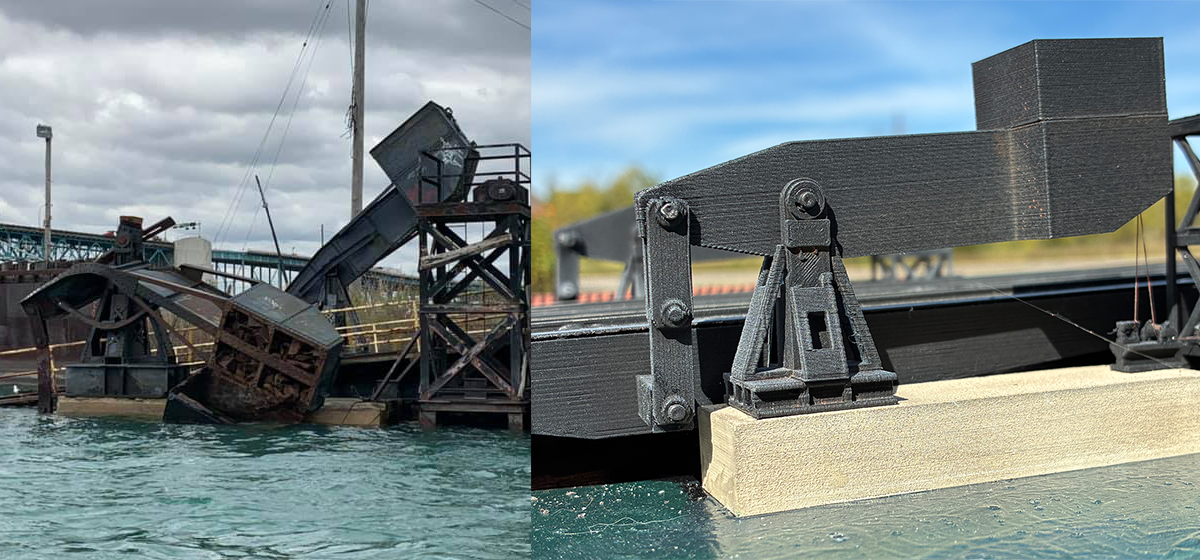
Counterweights
These were very difficult to get right as far as looks and mechanics.
Thanks to some fisherman who had an interest, I found some great prototype images.
Parts were designed in Sketchup-Free Version and 3D printed as 2 sections (bottom and arms) and assembled.
Small nails were used for the pivot pins.
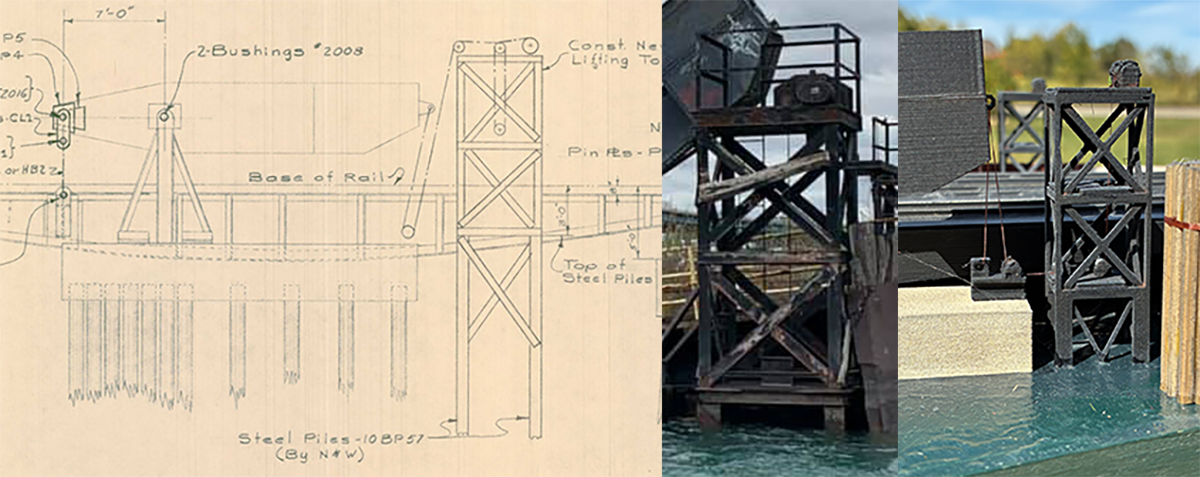
Winch Towers
Very little reference available for these!!
Each tower is different.
Thank goodness for local fisherman! as their photos of the old towers gave me the extra detail views I needed.
All tower parts were designed in Sketchup-Free and 3D printed.
The tower was made in 6 parts which were then glued together.
Winches were 3D printed as well and threaded as close to the prototype method as possible.
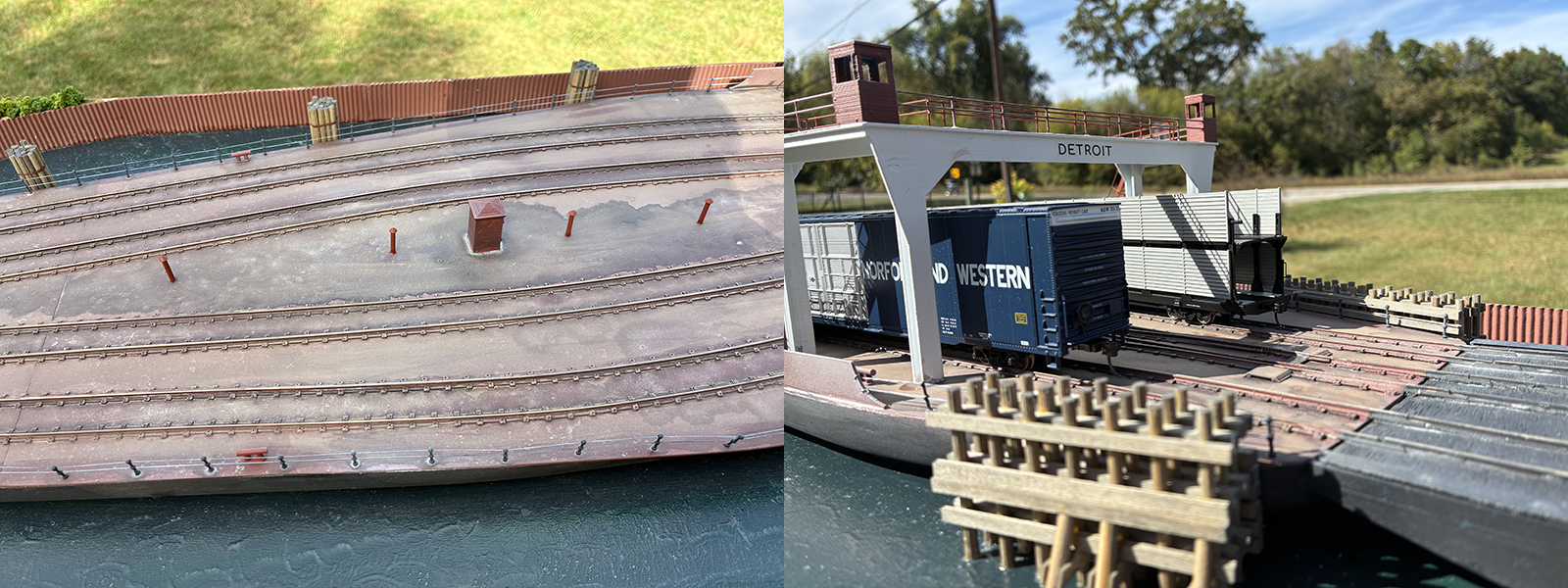
Details, Details and More Details
As with any model, we need details to make the scene.
- Pipes in deck, Tichy stove pipes
- Deck shed, from scrap box, may be a roof stairway
- Deck details from Frenchman River (bumpers, cleats)
- The water effect was done with gloss modge podge and a fan brush
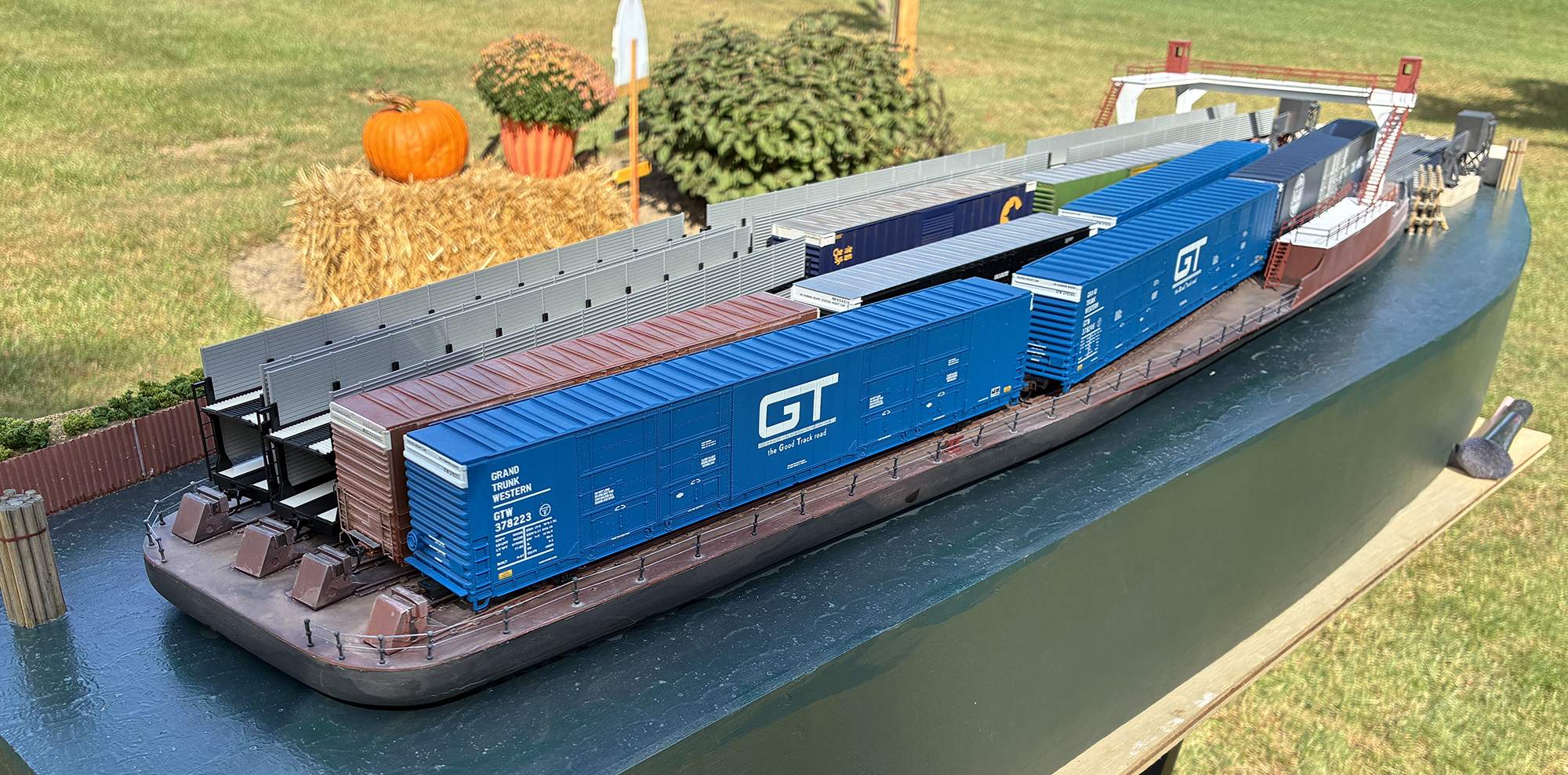
OMG, It's a Boat!
After a long period of inactivity, doing MY VERY MOST allowed me to achieve my goal.
This model is not intended to win any show or be a perfect scale model. This model is part of a Free-mo module set and is designed for operations! Models in the show circuit take a lot of bumps and things break! thismodel was designed and built knowing it would have to endure the riggors of the show life.
I truly knew I had acheived my realism goal when my wife (who had seen me working on this for a long time) one day said, "OMG, It's a Boat?". All this time she knew it was train related but until the bridge and details went on she trukly did not know what it was. I was also approached at a recent show by an attendee who acknowledged that he knew it was the Boat Yard and the Detroit as soon as he saw it. That is mission accomplished!
Some closing thoughts
Layouts are never truly finished and the same can be said of modular layouts. There are things about this model which did not turn out as I planned and I had to shift direction
a few times. Future planned upgrades include:
- Re-pour of the water with Envirotext Lite to give a deeper affect.
- Addition of deck details and running lights as additional barge photos are found.
- People will be added.
- Working lights for the bridge.
Upcoming Events
If you know about an event happening in our division (or nearby), please let us know so we can make everyone aware. If a club is having an open house, setup, or other activities, we could help promote it!